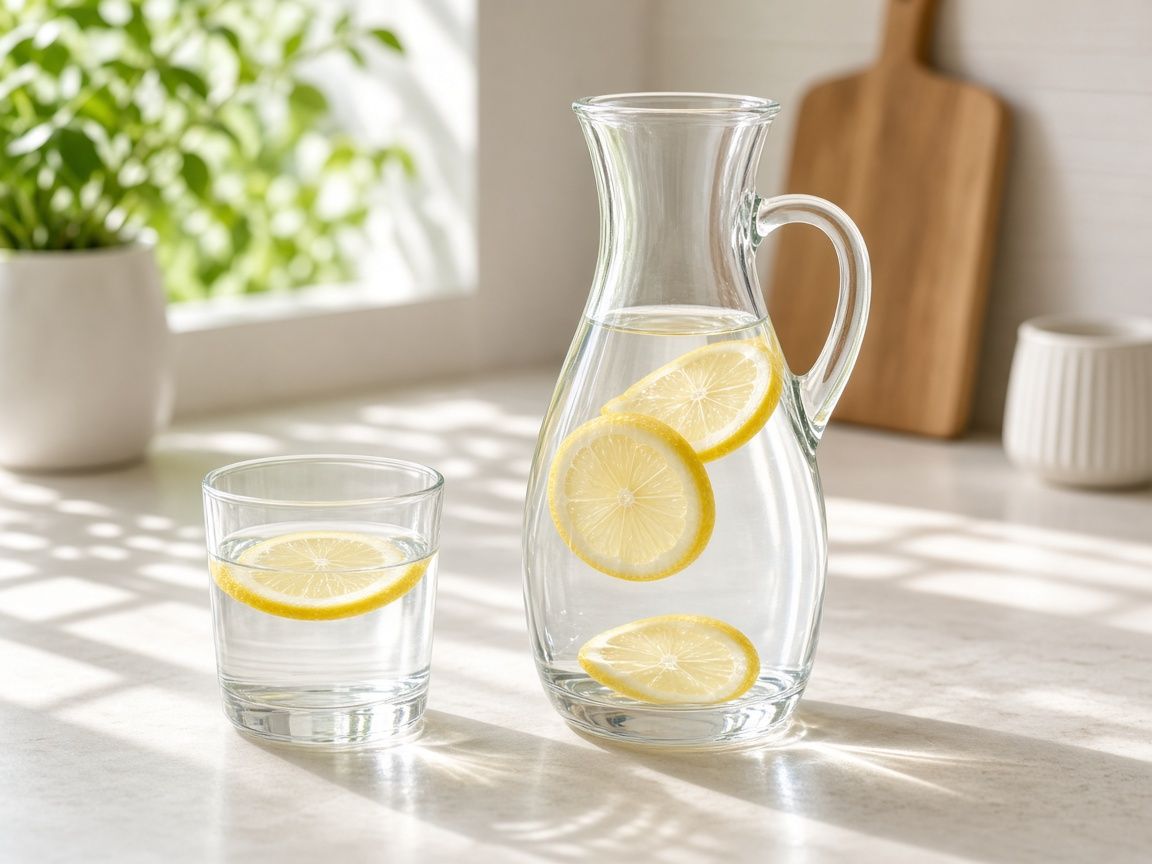
Most of us already know we should drink water. The knowing is not the hard part. The hard part is remembering in the middle of a day that is already full of other, louder requests. By late afternoon the glass is still in the cupboard.
I am not interested in strict trackers, ambitious gallon goals, or turning water into a project with a score. Those approaches work for some people for a week and then quietly disappear. What has worked, in my own kitchen, is much plainer: put water where your hands already go, and let a few ordinary cues do the remembering for you.
The carafe beside the kettle
The most useful change I made was also the smallest. I filled a clear glass carafe and set it beside the kettle, with a tumbler upside down next to it. In the morning, when I reach for the kettle, I pour a glass of water first. I drink it while the water heats for coffee or tea. The carafe is simply in the way, in the kindest sense.
Visibility matters more than intention. A bottle in a closed bag does not remind anyone of anything. A carafe on the counter does. I refill it when I refill the kettle, which means the habit attaches itself to a ritual I already keep. If you do not use a kettle, the same idea works beside the coffee maker, on the dining table, or next to the bathroom sink—anywhere your morning already has a pause.
A glass where you actually sit
The second cue is even less glamorous: a glass or bottle that lives where you work or read, not in the kitchen you keep leaving. I used to fill a tumbler, set it by the stove, walk to my desk, and wonder at noon why I had not drunk any of it. The water was in the wrong room.
Now a simple bottle sits on the desk when I am writing, and a second glass lives on the nightstand, poured when I turn out the kitchen light. I am not trying to meet a number. I am trying to make the next sip the path of least resistance. If the bottle is empty, I fill it on the way back from lunch, the way I would carry the mail in from the porch. Habit stacking is only a formal name for this old idea: attach the new thing to a thing you already do.
Flavor, if it helps you reach for the glass
Some people love plain water and some people do not. If a few slices of lemon, a sprig of mint, or a wheel of cucumber in the carafe makes you actually pour a glass, that is a practical choice, not a decoration. In winter I sometimes add a strip of orange peel. In summer, a handful of berries at the bottom of a pitcher in the refrigerator can be enough to make the first pour feel like a small pleasure.
Keep it light. The point is still water, not a project that requires a trip to a specialty store. If you would rather drink it plain and cold, keep a bottle in the refrigerator door, where you already stand when you are thinking about lunch. Taste is a tool. Use the one that makes the habit easier to keep.
An afternoon walk as a natural pause
The other habit that has stayed with me has almost nothing to do with a kitchen counter. Mid-afternoon, when the day starts to blur, I take a short walk—around the block, down to the end of the street, sometimes only as far as the corner and back. I bring a bottle. I drink some of it before I leave and some of it when I return. The walk is the reminder. The water goes with the fresh air.
This is not an exercise program, and it does not need special clothes. Ten minutes will do. If the weather is unfriendly, I stand on the porch or open a window and take the same pause: leave the desk, drink a glass, come back. The body likes a change of room. The habit likes a cue that is already pleasant. Combining the two has done more for my afternoons than any reminder on my phone.
Gentle, not strict
I do not restart a streak if I forget, and I do not treat a forgotten glass as a moral report. A habit that scolds you is a habit you will eventually hide from. A habit that is sitting on the counter, filled and obvious, does not need a lecture. There will be days of travel, long meetings, and evenings when the carafe is still half full at bedtime. That is ordinary life, not a failure of character. The next morning, fill it again when you fill the kettle. The method is forgiving on purpose. Forgiving methods are the ones that are still in the kitchen in February.
A small setup, once
If you want a place to start, do it once this evening. Choose a carafe or a clear bottle you like enough to leave out. Rinse it, fill it, and set it where tomorrow’s first kettle or coffee will happen. Put a glass beside it. If you have a lemon, slice a little into the water. If you do not, leave it plain. Set a second bottle where you sit in the afternoon, or by the door if you already take a walk.
That is the whole system: water within reach, attached to a morning you already have and an afternoon pause you can keep. No new personality is required, and no special equipment beyond a vessel you can see through. The days feel a little kinder when the simple things are easy to find. A full carafe on the counter is one of the simplest.